Summary
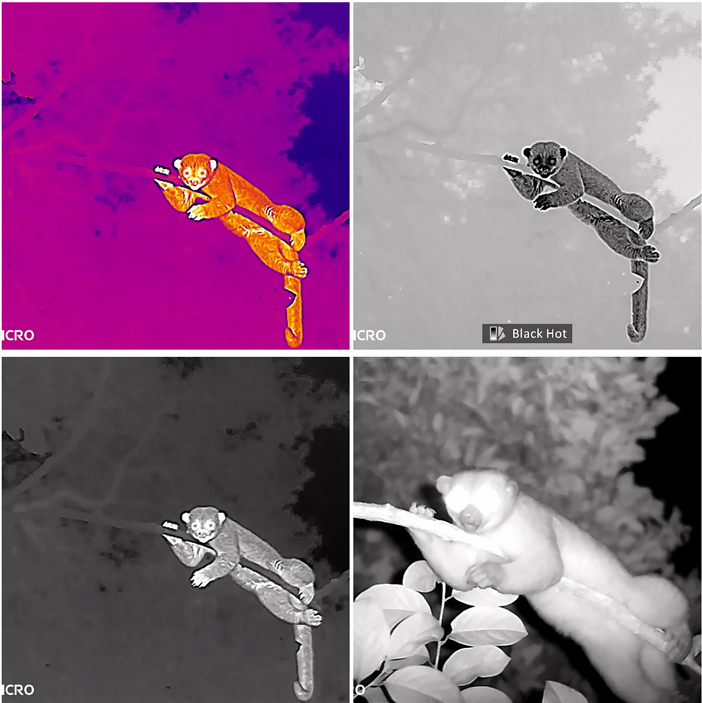
Thermal optics are revolutionising ecological survey, whether attached to drones, tripods or handheld. In this talk you’ll hear how scientists in Panama study of one of the most challenging mammal groups – nocturnal arboreal tropical mammals – by getting up close and personal with them at night in the canopy itself.
Description
The tropical canopy is one of the least explored and documented terrestrial habitats. It’s arboreal mammal fauna, ranging from tiny rodents to large sloths, and often nocturnal are critically understudied and understood. This structurally complex, three-dimensional zone is challenging to survey, and methods from the ground or the air miss a lot. Arboreal camera traps provide one solution, but each trap surveys a tiny zone.
Two ecologists in Panama realised that to study these species they had to get up into the trees at night. Thermal optics, increasingly affordable and capable, have provided the tool to do so. Using rope climbing techniques the ecologists sit high above the ground on portable platforms and have a 360°, floor to canopy view.
In this talk and discussion, the ecologists will explain the surprising findings, published this year in Mammal Research and Journal of Tropical Ecology, including how this approach can detect species missed by arrays of camera traps, and allow collection of behavioural data on little-studied species, not possible in any other way.
Lucy N. Hughes is a scientist with Conservation through Research, Education, Action (CREA) and the Margay Project. She is a Visiting Research Fellow at Edinburgh Napier University. She specialises in mammalian and tropical ecology.
Trevor Hughes is a technical specialist with Conservation through Research, Education, Action (CREA). He has particular expertise in ecological survey technologies including thermal optics, camera traps and passive acoustic monitoring and as well as rope access methods.